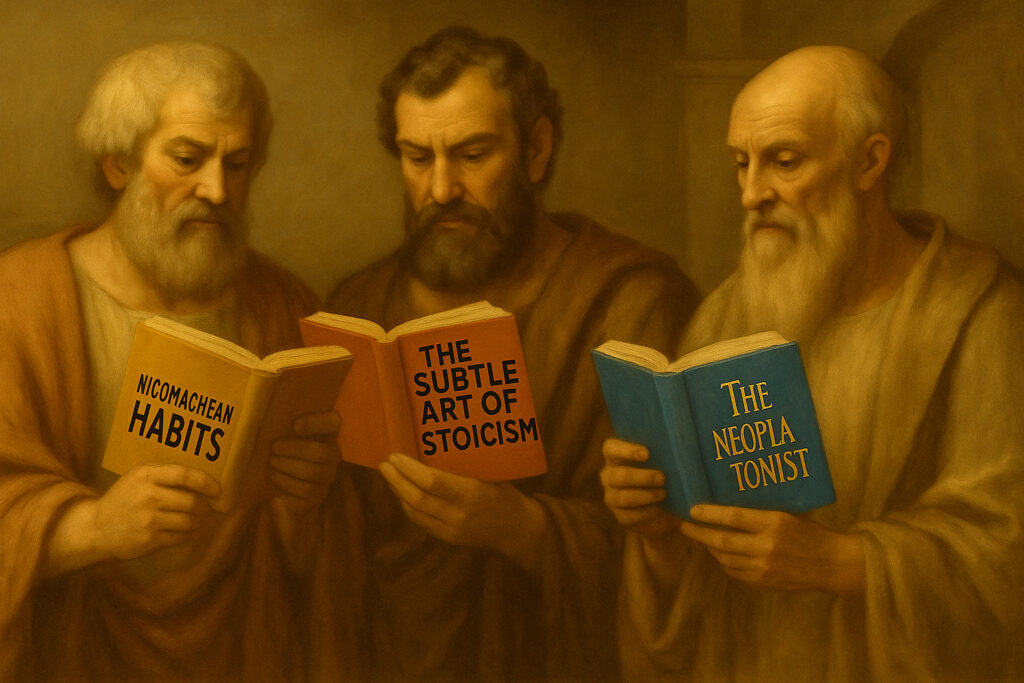
The phrase “philosopher CEO” first came up in a work conversation. It was used to describe a leader who, when asked a straightforward question by a reporter, didn’t stick to the punchy one-liner we had prepared. Instead, he circled the question, examined it from different angles, and offered a more layered answer than the journalist was probably looking for.
At first, it just sounded like an amusing way to describe someone who overexplains. But the wording stayed with me. What would a philosopher CEO actually look like? Could Platohave run a Fortune 500 company? Would Aristotlesurvive an earnings call? The thought experiment felt a little ridiculous, and yet, the more I considered it, the more sense it made.
To put the idea to the test, I turned to research. McKinsey has published one of the largest studies ever on CEO effectiveness, analyzing performance data from 7,800 CEOs across 3,500 companies in 70 countries, combined with 25 years of hands-on advisory work. From that research, they distilled a set of traits and practices that consistently define the most successful CEOs.
And here’s the surprising part: those traits align almost perfectly with timeless philosophical ideas. Which suggests the philosopher CEO might not be a joke at all, but a model worth taking seriously.
Fortune Favors the Bold
McKinsey’s research showed a simple but striking pattern: the best CEOs don’t just manage the business, they bet on it. Companies that made one or two bold moves, like entering a new market or launching a major product, were more than twice as likely to climb into the top tier of performance. Three or more bold moves, and the odds jumped sixfold. Playing it safe might look sensible on paper, but in practice it often leaves you stuck in the middle.
This is exactly the kind of leadership Niccolò Machiavelli had in mind. He argued that fortune rewards those willing to act, even when the outcome is uncertain. He wasn’t praising recklessness, he was pointing out that waiting for the perfect conditions is often the bigger risk. Sometimes you have to tilt the board and make the future happen.
For a philosopher CEO, that doesn’t mean scattering bets everywhere. It means picking a few moves that really matter, putting real weight behind them, and accepting that some people will be uncomfortable. Boldness feels disruptive by design, that’s how you know you’re not just circling the status quo.
“All courses of action are risky, so prudence is not in avoiding danger, but calculating risk and acting decisively. Make mistakes of ambition and not mistakes of sloth. Develop the strength to do bold things, not the strength to suffer.”
A brilliant strategy without the right people to carry it out is just paper. McKinsey’s research makes it clear: the best CEOs put as much effort into talent and culture as they do into markets and capital. In fact, companies where leaders actively measure and manage cultural health are more than twice as likely to see their strategies actually happen. Culture isn’t about posters on the wall, it’s about who gets hired, promoted, rewarded, and, when needed, shown the door.
Confuciuswould have nodded in agreement. He believed that people naturally follow the example of their leaders, and that a society thrives when upright people are placed in positions of influence. The philosopher CEO doesn’t just talk about values, they elevate people who embody them. Culture is shaped less by slogans and more by the everyday behavior of those who set the tone.
What does that look like in practice? You define a small set of non-negotiable behaviors that matter most in your context. You look for those behaviors when hiring, and you reinforce them when reviewing performance. You celebrate stories that show your values in action, rather than just listing them in a handbook. And you treat developing your leadership bench not as an HR formality, but as one of the most strategic moves you can make.
The pitfalls are obvious but common. One is “culture theater,” where lofty values are announced but never lived. The other is tolerating the brilliant jerk, the person whose results buy them permission to poison the team.
“Raise the straight and set them over the crooked. In this way, the crooked can be made straight.”

McKinsey found that when the top team is aligned, results follow. Companies where leadership teams truly pull in the same direction are almost twice as likely to beat the average in performance. And great CEOs don’t just hope good judgment will carry them through—they actively fight bias with tools that surface blind spots and keep decisions sharp.
This is where Aristotlecomes in. He argued that when people combine their perspectives, the result can be more than the sum of its parts. That’s the heart of disciplined teamwork: not replacing individual judgment with process, but creating a system where different viewpoints strengthen the final call. The philosopher CEO knows that disagreement isn’t a nuisance, it’s the raw material that turns shaky ideas into strong ones.
Practically, that means designing decision-making to make the most of the team. Keep information sessions and decision sessions separate. Make it clear who owns the final call. Before deciding, consider real alternatives and ask what evidence would change your mind. Give someone explicit permission to argue the counter-case. And once the choice is made, write down what was decided, why, and when you’ll revisit it.
The discipline matters. Too many leaders confuse rehashing old debates with careful thinking. In truth, that’s just drift. The philosopher CEO recognizes that clarity comes from combining perspectives into something new, and then moving forward.
“In the case of all things which have several parts … the whole is something besides the parts.”

Most leaders talk about purpose, but too often it amounts to a glossy paragraph in the annual report. Immanuel Kant gives us a sharper lens: treat people as ends in themselves, never just as means. That principle doesn’t live on a poster, it lives in how you set prices, how you support customers, how you treat suppliers, and how you handle layoffs. A purpose that actually guides decisions feels less like branding and more like a compass.
McKinsey’s research backs this up. They found that the best CEOs go beyond profit by actively reinforcing a corporate “Why” that benefits society as well as shareholders. And the results are tangible: when people feel respected—as employees, partners, or customers—they give back in trust, loyalty, and performance.
For the philosopher CEO, this means building systems that reward fairness, not just efficiency. It means asking not only “Will this work?” but also “Is this right?” It means putting people who embody your values into positions of influence and letting those examples ripple through the culture. Confucius framed it as raising the straight over the crooked; Kant gave it the moral imperative. In business, it looks like dignity translated into daily practice.
“Act so that you treat humanity … always as an end and never as a means only.”

Running a company is as much an inner game as an outer one. McKinsey’s research shows that the most effective CEOs guard their time carefully, lean on a small circle of trusted advisors, and keep their role in perspective. In other words: they don’t just run the business, they manage themselves.
Marcus Aurelius is the natural guide here. He reminded himself daily not to waste energy debating what a good leader should be, but to simply be one. He urged us to guard the “citadel” of our mind, because most pain arrives not from events themselves, but from our judgments about them. For the philosopher CEO, this means walking into tense rooms with their principles intact, less about quoting wisdom, more about living it.
That looks like keeping a short list of real priorities and defending it from drift. It means creating time to think, not just to react. It’s about sharing the reasoning behind hard calls so others don’t have to invent their own stories. And it means being humble enough to look for truth in criticism, while remembering that praise belongs more to the role than the person.
Authenticity here doesn’t mean spilling every thought or insecurity. It means consistency. People notice whether you’re the same leader when the numbers are up as when they’re down. The philosopher CEO doesn’t just talk about integrity, they carry it, especially when it matters most.
“No longer talk about the kind of man that a good man ought to be, but be such.”

So what happens when wisdom runs a company? You get leaders who are bold without being reckless, people-focused without being naïve, disciplined without being rigid, principled without being preachy, and grounded without being aloof. That’s what McKinsey’s research shows in numbers, and what philosophy has been arguing in words for centuries.
Of course, there’s a danger in leaning too far the other way. A CEO who only philosophizes risks drifting into endless reflection while the competition eats their lunch. The trick is to treat philosophy as a toolkit, not a straitjacket, to know when to channel Machiavelli’s daring, Confucius’ moral clarity, Aristotle’s deliberation, Kant’s duty, or Marcus Aurelius’ self-mastery.
In that sense, the philosopher CEO isn’t a dreamer in the boardroom. They’re someone who can pause, reflect, and then act with both courage and conscience. Which, when you think about it, might be the most practical definition of leadership there is.